 RICORDI
DI ZIO FRANCESCO
RICORDI
DI ZIO FRANCESCOdi Jim Pensiero.
I first met Francesco Zenobio and his wife, Angelina, and their children, son Lino and daughter Maria, in September 1981, at their home in the small town of Santa Maria di Infante, Lazio, Italy.
The Zenobio family and the town of Santa Maria are extremely important in my family’s history. My grandmother, Antonia Zenobia Pensiero, was born in Santa Maria, as was my grandfather, Francesco Pensiero. My grandfather emigrated to Philadelphia, Pennsylvania, early in the 20th century. Francesco Pensiero returned to Italy to marry my grandmother around 1910. Francesco and Antonia had six children; he died in 1953 and she died in 1974. Of their six children—Maria, Nancy, Nicholas, Benjamin, Gloria and John—only three are still living today. My father, Nicholas F. Pensiero, was born on March 4, 1918 and died on February 26, 2003 at the age of 84. Nicholas Pensiero and his wife, Dorothy Ann, have six children—Theodore, James, Mary Ann, Mark, Nicole Marie, and Benjamin—and nine grandchildren.
Francesco Zenobio was my father’s first cousin, as Francesco’s father and my father’s mother were brother and sister. My grandmother over the years had kept in touch with her side of the family in Italy, even returning for a visit to Santa Maria in the early 1920s accompanied by her young son Benjamin John. On my most recent visit to Santa Maria, in 1996, I met an old man in Santa Maria who remembered that visit by my grandmother and uncle. This man said my grandmother was the best-looking girl in Santa Maria when she was young. For the record, my uncle Benjamin is 83 years old and lives with his wife, Angelina Merlino Pensiero, outside of Philadelphia. While the Zenobios stayed in contact with each other, I have never met any members of the Pensiero family in Italy—although Francesco Zenobio said a number of them live in and around the vicinity of Minturno, Italy.
As for the Zenobios, Francesco’s brother Antimo (we called him Andy) moved to the United States after World War II, spending time with his aunt and uncle and cousins in Philadelphia (the Pensieros) before moving to California. My father and Uncle Andy were very close and our families stay in contact with each other. My cousin Richard Zenobio, who is Antimo’s only son, often visits Italy and speaks beautiful Italian. Richard, unlike me and my siblings, also has the artistic streak for which the Famiglia Zenobio is rightly well known.
The visit I made to Italy in September 1981 was my first trip to that country. I was accompanied by my father, who was then 63 years of age. He had met his cousins in Santa Maria on several prior occasions, and wanted me to learn about my family’s history. What better place to start than where his family originated.
As is the custom, we took an overnight flight from New York to Rome, and then took a train from the Roma Termini station to Minturno. We were met at Minturno by Francesco Zenobio, who I immediately began to call Zio—or Uncle—as he was close in age to my father.
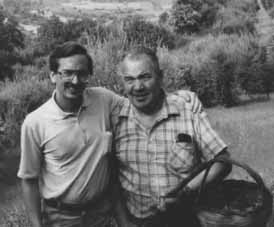
Francesco drove a French car—I believe it was a Renault—and he was driving the same car the last time I saw him in 1996. He was a thrifty man who didn’t waste a lot of time or money on automobiles.
I could not speak Italian, so I had to keep up the best I could when my father and Francesco spoke. But I did learn a lot about our family from Francesco, his very charming and kind wife Angelina, and his children.
In listening to my father and Francesco speak and through my own observations and experience, I learned the following about Zio Francesco:
--He was a very intelligent but modest man. He knew everything there was to be know about Minturno, Formia, Santa Maria and the surrounding vicinity—along with quite a bit about Rome and the rest of Italy—but he maintained a low-key style and was never boastful or arrogant.
--Francesco was a great farmer, and knew how to make things grow. He raised olives, grapes, stringbeans, figs, tomatoes, herbs and everything else you could think of. Francesco also made delicious—and strong (forte!)—wine and excellent olive oil. The food at the Casa Zenobio was absolutely spectacular—some of the best I have ever tasted. Francesco never let me leave the table without eating more than I should have. In that way, he reminded me greatly of my grandmother and my Uncle Andy in California.
--Francesco had a great interest in local and world history. Some of that interest came because he had survived the Second World War, serving in the Italian Army and then spending some time in a German internment camp in Poland after Italy withdrew from the Axis. Santa Maria is in south-central Italy and thus a very temperate place. Francesco said he had never been so cold in his life than during that winter in Poland. He told me that that difficult experience had made him appreciate every day of his life, and I certainly believe him. His wife Angelina, meanwhile, told me that her family fled from Santa Maria during the height of fighting between the Germans and Americans in the winter of 1943—living in caves in the mountains to the northeast of town and suffering greatly from hunger and cold. The war was very difficult on Santa Maria. Francesco told me that the town changed hands three times in heavy battle between the Americans and Germans. He showed me photographs of the ruins of Santa Maria when the fighting was finally over. There were a few walls standing as the town was virtually destroyed. In the center of Santa Maria there was and remains a War Memorial listing the names of all those who died in the Second World War. There are many names on this monument, especially when you consider what a small town Santa Maria is. I know that my Italian cousins know how difficult war can be, but they bore no malice or anger toward the Americans who were partially responsible for the destruction of their town. War, they told, was something that we experienced and that should be avoided at all cost.
--Francesco and his family were always very generous and hospitable. I have visited Santa Maria four times, and each time I was treated with kindness and friendship. When my eldest daughter Gina (who was at the time 12 years old) accompanied my father and myself to Santa Maria in 1996, Francesco and Angelina went to great lengths to make her feel at home. Both Francesco and Angelina knew that Gina, a young person who didn’t speak the language, would be awkward and a little afraid. They took the time to show her around, to let her play with their cat, to walk the streets of Minturno and to get her a doll of the local peasant dress as a memento. This sort of generosity of spirit will always endear me to my Santa Maria cousins. The Zenobio family has always treated its distant cousins in America with the greatest warmth and generosity. I look forward to the day when I can return the favor to any of my Italian cousins.
In America we have an expression for a man such as Francesco Zenobio—who in many important ways reminded me of my father and my Uncle Andy. Francesco Zenobio “lived large’’—and by that we mean he experienced many important things in life and that he always gave more than he received. He was a wonderful man and I miss him greatly. If there is a heaven, I’m sure he is sitting at a table with his brother and my father, sipping wine, enjoying good Italian fruit and cheese, and telling stories to each other.